WiFi Marketing in South Africa: How Guest WiFi Is Becoming a Powerful First-Party Data & Advertising Channel
Every day, thousands of South Africans connect to free WiFi in shopping centres, restaurants, hotels, events, transport hubs, universities, retail stores and public spaces.
For most businesses, WiFi is still treated as a utility.
Customers connect. They browse. They disconnect.
But what if that WiFi network could do more?
What if it could help your business understand who visits your locations, grow a permission-based customer database, deliver targeted advertising, collect customer feedback and measure engagement?
That is the opportunity behind WiFi marketing.
As businesses increasingly look for ways to build first-party customer data and connect physical customer experiences with digital marketing, guest WiFi is becoming an increasingly valuable marketing and customer intelligence channel.
The bigger idea is not simply WiFi marketing. It is the creation of connected customer ecosystems.
What Is WiFi Marketing?
WiFi marketing uses a business's guest WiFi network as a digital customer engagement channel.
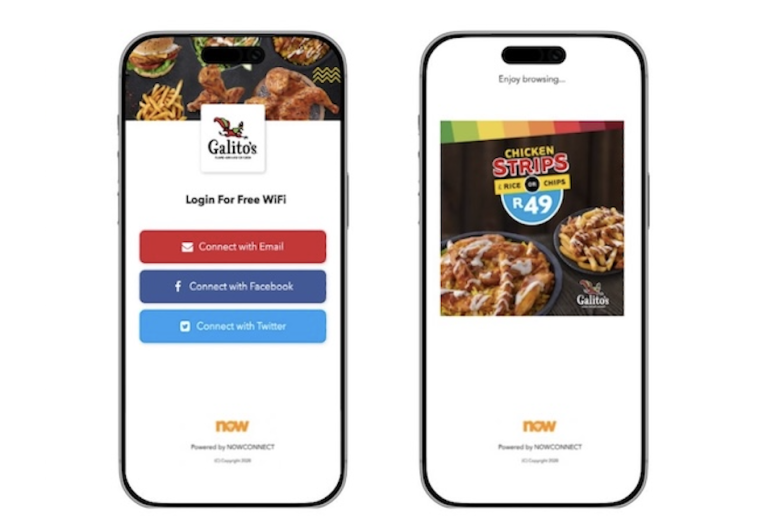
Instead of customers simply entering a password and connecting to the internet, they are presented with a branded WiFi landing page — commonly known as a captive portal.
The portal can allow customers to access WiFi through options such as email, mobile number or another approved authentication method.
With the appropriate customer consent and privacy controls, that interaction can transform an anonymous WiFi connection into a measurable customer touchpoint.
Businesses can use the experience to:
Display advertising and promotions
Capture permission-based customer information.
Conduct surveys
Generate leads
Promote products and services.
Encourage app downloads
Collect customer feedback
Build CRM audiences
Run competitions
Measure campaign engagement
The result is simple:
Free WiFi becomes more than connectivity. It becomes media, data and customer engagement infrastructure.
How Does WiFi Marketing Work?
Customer enters a WiFi-enabled location
This could be a shopping centre, restaurant, event, taxi rank, hotel, retail store, university or other public environment.
Customer selects the guest WiFi network
Instead of immediately receiving unrestricted access, the user is directed to a branded captive portal.
The customer authenticates
Depending on the campaign and privacy requirements, the customer can provide approved information and marketing consent.
The customer sees branded content
The WiFi experience can display promotions, campaign creative, competitions, videos, surveys or calls to action.
The customer connects
The customer receives internet access while the platform records permitted engagement information.
Data becomes customer intelligence
Aggregated information can help businesses understand campaign performance, customer behaviour and repeat engagement.
This creates a bridge between the physical customer journey and the digital marketing ecosystem.
Why First-Party Data Matters
Digital marketing has historically depended heavily on large advertising platforms and third-party audience data.
Businesses are increasingly recognising the strategic value of developing their own customer data.
First-party data is information collected directly through interactions between an organisation and its customers.
This could include:
Website registrations
Purchases
CRM records
Loyalty programmes
Surveys
App interactions
Event registrations
Customer enquiries
Guest WiFi interactions
For organisations with significant physical footfall, WiFi provides another opportunity to build this customer intelligence.
Consider a shopping centre receiving thousands of visitors every week.
Traditional footfall technology might tell management how many people entered the property.
WiFi CRM can potentially add another layer of insight by helping the organisation understand consenting customers who engage with its network.
The strategic difference is significant.
Instead of only knowing:
“20,000 people visited.”
The business can begin asking:
How many connected?
How many were new visitors?
How many returned?
Which campaigns generated engagement?
What are customers interested in?
What feedback are they providing?
That is the transition from footfall measurement to customer intelligence.
The Future of WiFi Is Customer Intelligence
WiFi infrastructure has traditionally been viewed as an IT expense.
That thinking is changing.
When connectivity, CRM, wifi advertising, analytics and customer experience are integrated correctly, WiFi can become part of an organisation's marketing infrastructure.
A shopping centre can turn connectivity into customer intelligence.
A restaurant can turn guest WiFi into repeat engagement.
An event can turn attendees into measurable audiences.
A transport environment can combine connectivity with public communication and commercial media.
A retailer can connect physical footfall with digital customer relationships.
The bigger idea is not simply WiFi marketing. It is the creation of connected customer ecosystems. A WiFi CRM platform connects guest connectivity with customer relationship management capabilities.
Instead of treating every WiFi session as an isolated interaction, organisations can develop a better understanding of customer engagement over time — subject to consent and applicable privacy requirements.
This can help organisations distinguish between new and returning visitors and develop relevant customer segments.
Those audiences can potentially be integrated into broader communication strategies involving email, SMS, CRM platforms and digital advertising.
WiFi therefore becomes part of the organisation's wider customer-data ecosystem.
DigitalFWD is a digital-first, data-driven solutions partner that helps businesses grow by bringing technology, design, and marketing together into one connected ecosystem.
DigitalFWD is a digital-first, data-driven solutions partner that helps businesses grow by bringing technology, design, and marketing together into one connected ecosystem.